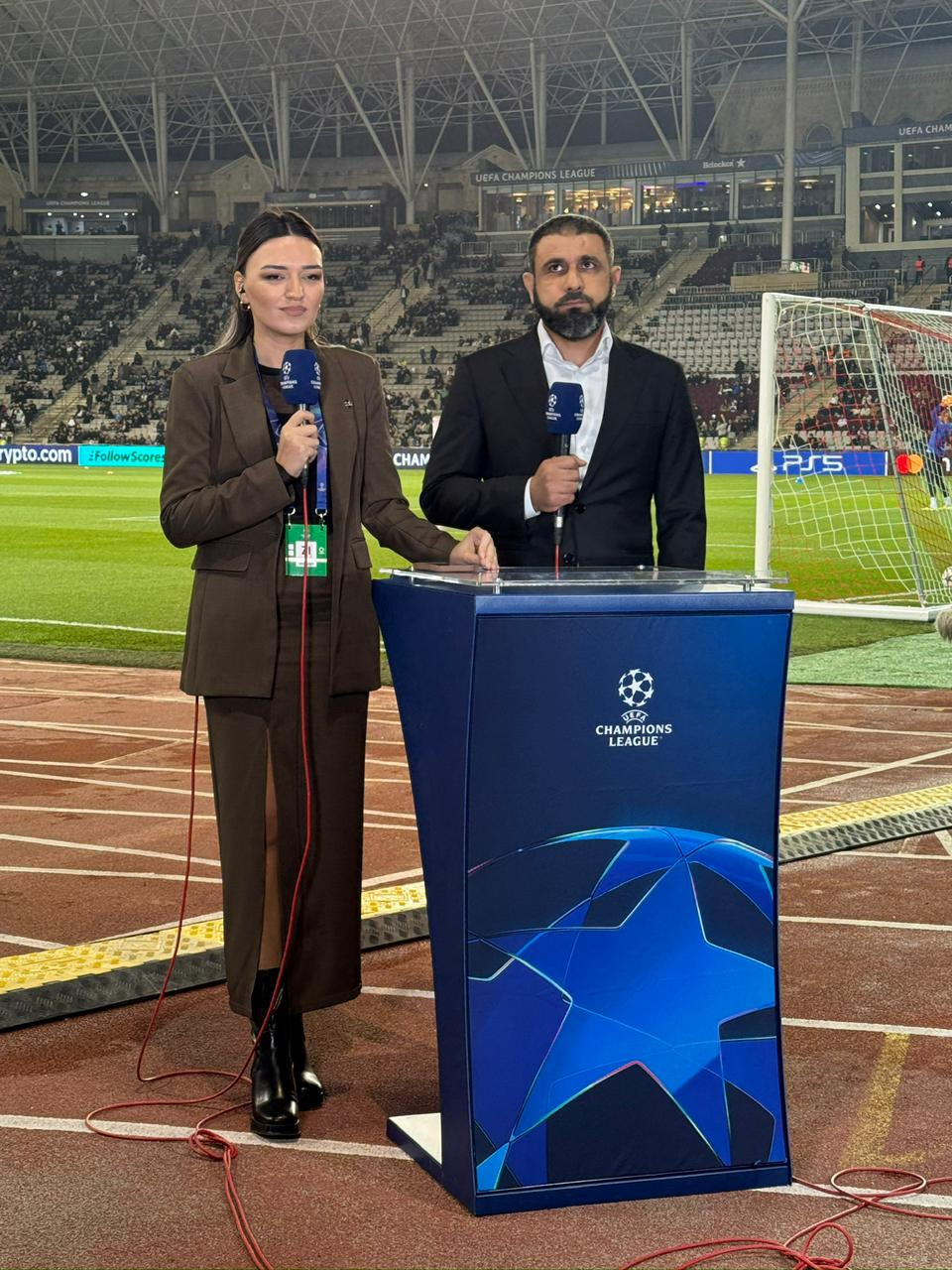

In the past, Azerbaijani girls watching television rarely saw women they could look up to in many sports—simply because female athletes were rarely shown. Today, however, girls can find inspiration not only in athletes but also in sports journalists. Women in sports media demonstrate that they can be experts and influential voices in the world of sport.
Yet there is still significant room for improvement in terms of gender representation in this branch of journalism worldwide. According to a study published in the Atlantic Journal of Communication, only 5.1% of 2,242 sports articles were written by women. Another report shows that although the share of female sports journalists increased between 2018 and 2021, their representation remains extremely low compared with men. Female sports journalists also frequently face sexism, stereotypes, and even sexual harassment.
Female Sports Journalists in Azerbaijan
For İctimai TV sports presenter Farida Abdulla, her love for the field began in childhood. She often watched major sporting events with her mother, and one of her most vivid memories is the Sydney 2000 Olympic Games.
She remembers getting ready for school and watching with her mother as Azerbaijani Olympic champion Zemfira Meftahatdinova received her medal. At the time, she didn’t know it was a historic moment for the country—the first Olympic gold for independent Azerbaijan.
"I never imagined that years later I would meet my childhood idol on a film set and share that memory with her,” she adds.
After her first major report, Abdulla felt both adrenaline and responsibility. Live broadcasting did not frighten her; on the contrary, it motivated her.
“In sport, seconds write history," she says. "You are a living witness to successes and sometimes disappointments—and the person who conveys all of this to viewers.”
 Photo: Farida Abdulla
Over the years, she has accumulated many memorable moments. One of the most significant was her trip to the 2024 Olympic Games. At the event that had first sparked her love for sport, Abdulla found herself on the other side of the screen—and in a special role.
On the initiative of Azerbaijan’s Ministry of Youth and Sports, she became the first female sports journalist in the country’s history to attend the Olympic Games as part of the national media delegation.
"It is a great honor and invaluable experience," Farida Abdulla says. "I understood that it was a new page for this field in our country, an important step. It is a road opened for women who will work in this direction."
 Photo: Farida Abdulla
The path of another sports journalist—radio host, and editor-in-chief of Offsideplus.az Gunay Khalil—began at the Faculty of Journalism at Baku State University.
During a training session where students worked on different topics, she prepared a radio report about Azerbaijan’s national football team. From that moment, sports journalism became especially close to her heart. She decided to pursue the field and began an internship at Offsideplus.az in 2020.
“Imagine standing in front of a person who has trained for more than half of their life," she says. "When they finally achieve the results they were striving for, having the chance to draw attention to it is one of the most wonderful feelings.”
The journalist has already worked on a number of projects she is proud of. Among them are the radio program “Offside” on Saglam Radio 93FM, coverage of UFC Fight Night in Baku, and an interview with Polish mixed martial artist Klaudia Sygula, which she considers one of her most interesting.
Khalil also recalls her trip to the Sweden–Azerbaijan football match (6:0) in 2024.
“Although the result of the game was disappointing, the press conference with Fernando Santos was interesting. I asked questions that I still like. As soon as I arrived in Baku, I left my suitcases and ran to the radio station. That broadcast turned out to be very interesting as well,” she says.
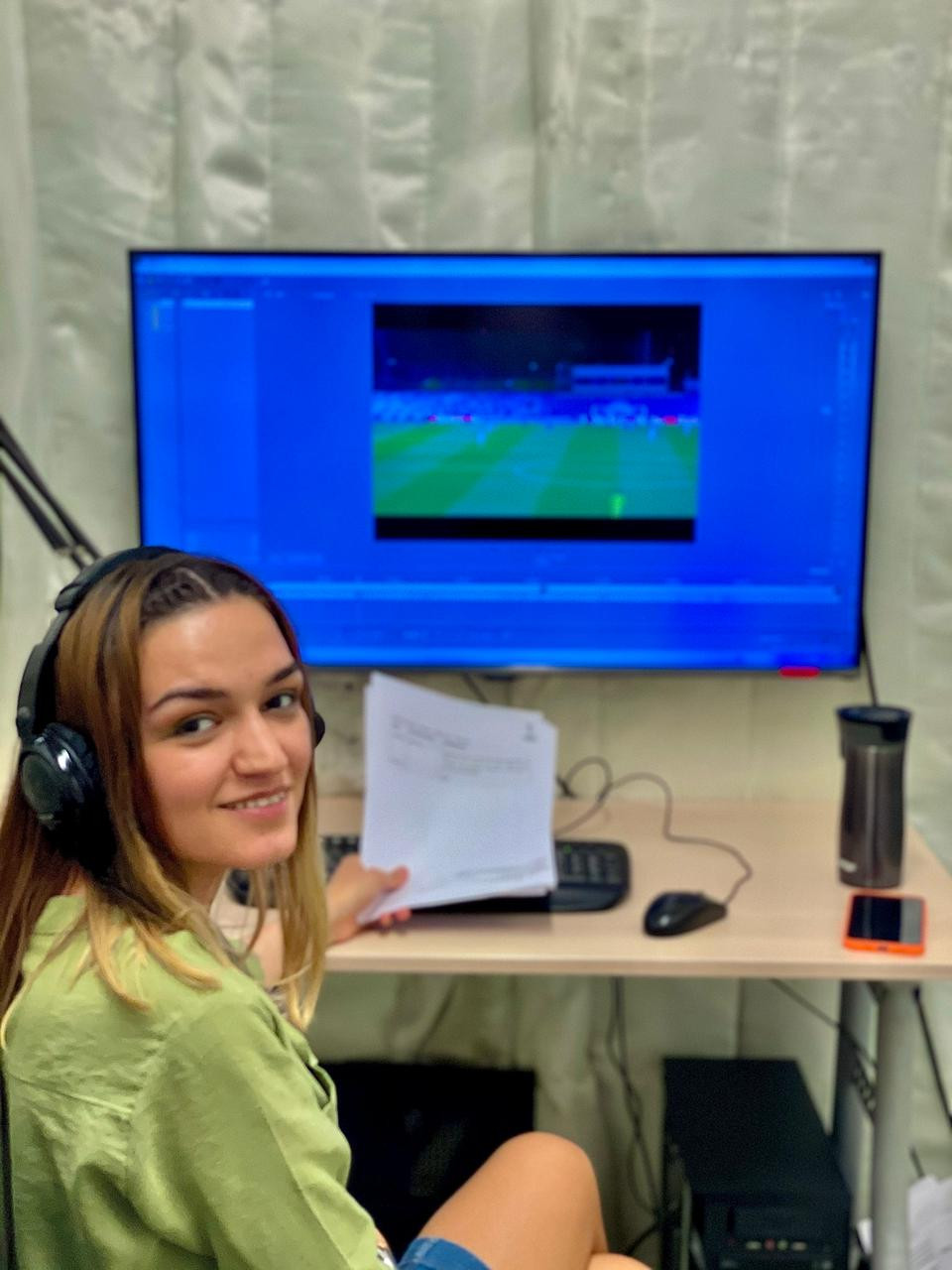
 Photo: Gunay Khalil
The story of CBC Sport presenter and commentator Aida Aliyeva began with a deep love—even fanaticism—for football. She admits that she chose journalism to be closer to famous athletes and other people from the world of sport.
“I protested very seriously: why don’t we have a sports journalism course?” she recalls of her university years. “Because from the moment I entered the journalism faculty, I knew I would become a sports journalist.”
One of the most memorable events of her career, she says, was the Qarabag–Braga match in 2024 (2:3, Europa League round of 32; Qarabag advanced to the round of 16 on aggregate). After the game, she conducted a quick interview with Qarabag head coach Gurban Gurbanov.
“When I put on my headphones, I was very nervous. Even while holding the microphone, my hand was shaking. Because, essentially, the only thing I wanted to do was thank Gurban Gurbanov for those emotions. Many years ago, when we watched European competitions, it never crossed my mind that an Azerbaijani team would dictate the terms and defeat big clubs.”
Dolma or football?
Being a female sports journalist sometimes means facing prejudice. At the beginning of her career, Farida Abdulla often heard the question: “What do women understand about sports?”
“Mostly it came from people with old-fashioned views on social media, and sometimes from within the sports community,” she says, noting that the situation is gradually changing.
At first such comments hurt her.
“Over time I realized that the best answer is the quality of my work. Life is a struggle, and I am always open to new challenges and competition. I feel that over the years I have become stronger.”
 Photo: Farida Abdulla
According to her, men who show negativity toward female journalists “try to hide their own failures and pour their poison on women.”
“I have always received support from women. I am glad that I can inspire girls,” she adds.
Journalists say such attitudes are often linked to the perception that sports journalism is still a “male sphere.”
“Usually the negativity comes from men. They think sport is not women’s prerogative,” says Aida Aliyeva. “I don’t know whether they are joking or serious, but they write that a woman’s place is in the kitchen. I think they are joking, because it is already a stereotype that is gradually disappearing.”
Recently, the CBC Sport journalist posted a humorous video on social media featuring some of the comments she receives—including suggestions that she cook dolma or soup.
View this post on InstagramApparently, many users consume sports content while hungry: Gunay Khalil has also encountered similar comments.
“Sometimes viewers traditionally suggest that I cook bozbash in the comments. But I don’t know how to cook bozbash. Maybe that’s why I became a sports journalist,” the Offsideplus.az editor-in-chief jokes.
At the same time, Khalil does not condemn the bias directed at her, noting that men still dominate many fields. According to her, people often feel irritation when representatives of another gender enter a sphere where they already have many years of experience.
“Perhaps female hairdressers were once a little irritated when men began working in beauty salons,” the radio host explains. “But over time, it became normal, and today we see talented men performing wonders in makeup and hairstyling."
“Women in sports journalism also need time to establish themselves in the profession," she says, adding: "If every girl who takes a step into this field is tripped up and discouraged from working, we will not see women’s potential in this area unfold for a long time.”
The journalists note that such a situation is a global trend. However, most often they have encountered support from colleagues and respect from interviewees.
Photo: Gunay Khalil
Why are there so few female sports journalists?
International data show that women are significantly underrepresented in sports journalism. Farida Abdulla notes that the profession is demanding both emotionally and physically.
Gunay Khalil believes that women generally show less interest in this field. According to her, some of her female colleagues later continued their careers in other areas of journalism.
“It seems to me that the number of female sports journalists is now growing. I see them more and more often at games, and it is nice. Breaking stereotypes is great,” she says.
Farida Abdulla is convinced that women are needed in Azerbaijani sports.
“A female perspective is different—it is more detailed, more empathetic, and sometimes bolder," Abdulla says. "Sport is not just statistics; it is stories. And women know how to tell stories.”
Aida Aliyeva adds that sports coverage in Azerbaijan lacks topics related to girls’ participation in sport. Encouraging girls to take up sport—especially in the regions—remains an important challenge due to mentality and other factors.
Photo: Aida Aliyeva
Khalil also believes that women’s sport is not covered enough. As an example, she cites the Azerbaijan women’s national football team, which, she says, achieves better results than the men’s national team.
Women in leadership positions — is it realistic?
“Unfortunately, our chances are not equal to men’s. Women have to work twice as hard to prove themselves,” says Farida Abdulla. At the same time, she believes the balance is gradually changing. “As professionalism begins to outweigh gender, career paths will become fairer.”
The İctimai TV presenter says she is trying to help change the situation herself. “I believe that women will now be regularly sent to major sporting events. I hope that at the next Summer Olympic Games I will not be the only sports journalist from Azerbaijan.”
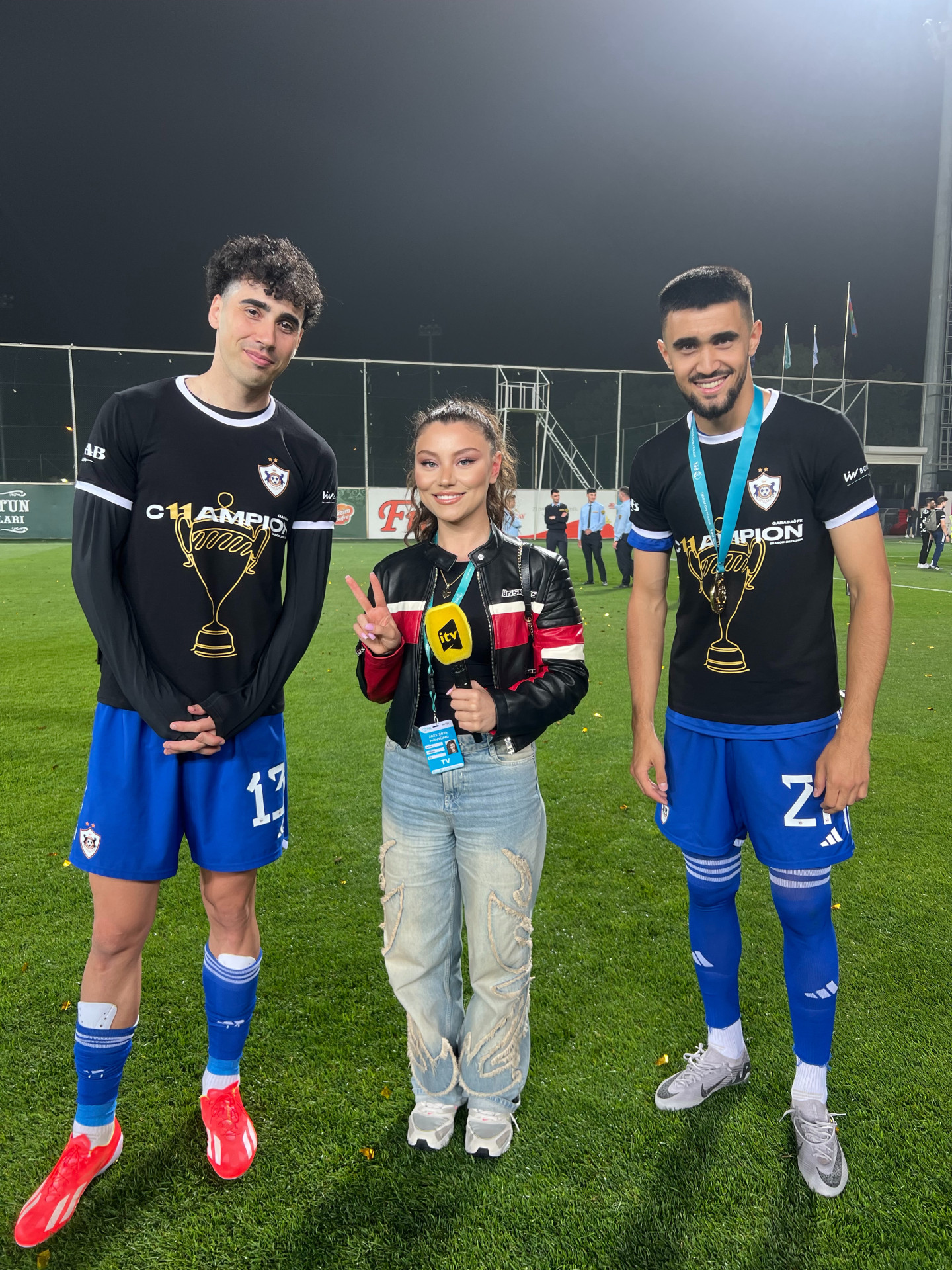
Farida Abdulla with Qarabag players Bahlul Mustafazade and Toral Bayramov. Photo: Farida Abdulla
By example, editor-in-chief of Offsideplus.az Gunay Khalil shows that women in sports journalism can accomplish a great deal, combining frontline reporting with team leadership.
She admits that outside the newsroom people have sometimes been surprised to learn about her position. However, within the editorial team she did not feel any difference after her promotion.
According to her, women can hold leadership positions, but much depends on the managers of media organizations.
“A sports journalist should not be evaluated by gender," she says. "When possible, women should also be sent on assignments. Believe me, many female journalists want to prove themselves in this field—they just need to be given the opportunity to show their work.”
Khalil also shared advice for girls who want to pursue a career in sports journalism.“Believe in yourself. Don’t be afraid of anyone,” she says. She also encourages journalists not to avoid asking questions at press conferences, adding that “there are no smart or stupid questions—only successful and unsuccessful ones.”
Aida Aliyeva agrees, adding that criticism should not discourage those interested in the profession. “If someone wants to work in this field, they must have a strong character," she concludes.
Photo: Aida Aliyeva