
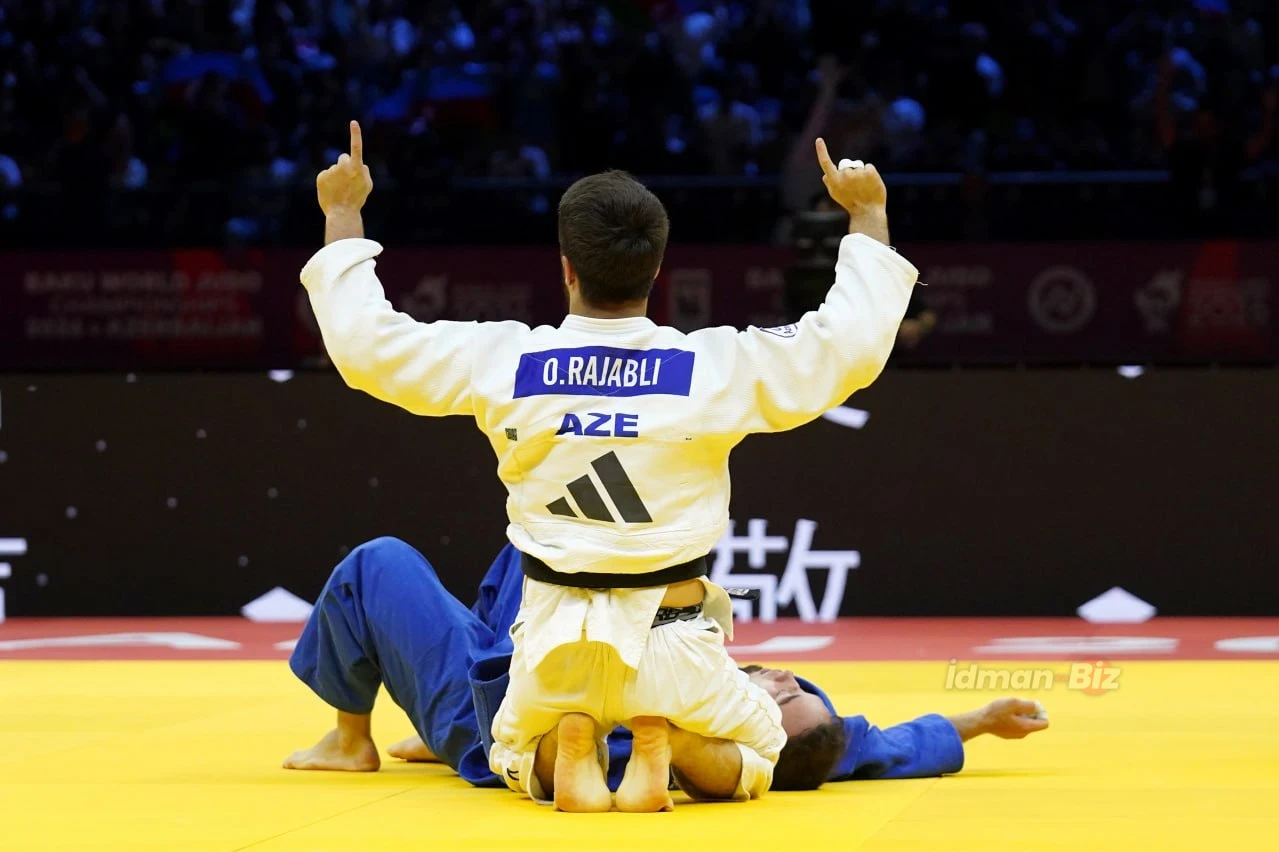
The World Judo Championships in Baku became the most successful in Azerbaijan's history in terms of medals won. Seven medals, third place in the overall standings and a new generation of world championship medalists represented an achievement that would have seemed difficult to imagine just a few years ago.
As reported by İdman.Biz, Azerbaijani judokas claimed one gold, two silver and four bronze medals, finishing behind only Japan and Georgia in the medal standings. The previous national record, set in Budapest in 2017, stood at four medals. By comparison, Azerbaijan managed just two medals when Baku last hosted the World Championships in 2018.
However, the true significance of this year's success goes far beyond the numbers.
Five New Names on the World Podium
Five of Azerbaijan's seven medalists reached the podium at a senior World Championships for the first time: Ahmad Yusifov (60 kg), Rashid Mammadaliyev (73 kg), Omar Rajabli (81 kg), Murad Fatiyev (90 kg) and Kanan Nasibov (+100 kg).
This remarkable renewal of the medal-winning lineup is perhaps one of the strongest indicators of the Azerbaijan Judo Federation's effective development strategy. The results were not achieved solely by established stars. Athletes who had previously remained in the shadow of their more decorated teammates demonstrated their ability to compete at the highest level.
The story of 22-year-old Omar Rajabli is particularly symbolic. He repeated the achievement of his father, Elkhan Rajabli, who won bronze at the 2001 World Championships. Remarkably, both father and son claimed their medals in the same 81 kg category, exactly 25 years apart.
Another 22-year-old, Kanan Nasibov, demonstrated that Azerbaijan also has promising prospects in the heavyweight division. His bronze medal, secured against national teammate Jamal Gamzatkhanov, provided a fitting conclusion to the team's record-breaking performance.
A Gold Medal That Had to Be Fought For
Ahmad Yusifov's victory deserves special attention, as he opened Azerbaijan's medal account on the very first day of competition.
In the 60 kg category, world ranking leader Balabay Aghayev was widely considered the host nation's leading contender. However, he suffered a surprising defeat to young American Jonathan Yang, while Yusifov overcame a series of formidable opponents to reach the final.
The decisive contest against Kazakhstan's Sherzod Davlatov became a genuine test of character. After conceding a waza-ari, the Azerbaijani managed to turn the contest around, level the score and eventually secure victory with a hold-down.
His triumph was no coincidence. Earlier this season, Yusifov won the Tashkent Grand Slam and claimed bronze at the European Championships. In Baku, accumulated experience, tactical discipline and mental resilience combined to produce a world championship title.
### Two Silver Medals, Two Different Stories
Zelim Tckaev (81 kg) improved on last year's performance, upgrading his World Championships bronze to silver. Only Georgia's Tato Grigalashvili prevented him from reaching the top of the podium, once again demonstrating why he remains one of the world's strongest judokas.
Meanwhile, Ushangi Kokauri (+100 kg) repeated his achievement from eight years earlier at another home World Championships. Having won silver in Baku in 2018, he once again reached the final, where he lost to three-time world champion Inal Tasoev.
The Russian has now defeated Kokauri eight times and appears to have become an almost insurmountable obstacle for the Azerbaijani heavyweight. This raises the question of whether the national team should increasingly invest in younger prospects, particularly Kanan Nasibov and Jamal Gamzatkhanov.
Rashid Mammadaliyev's bronze medal, meanwhile, continued his impressive progress in the 73 kg division. Shortly before the World Championships, he won the Budapest Grand Slam, confirming his ability to challenge the world's leading judokas.
Murad Fatiyev also demonstrated that his recent achievements were no accident. His victory over former world champion Nemanja Majdov of Serbia in the bronze medal contest was among the most significant results for the Azerbaijani team.
The 66 kg Division: A Problem or Untapped Potential?
Against the backdrop of Azerbaijan's record-breaking performance, the 66 kg category stands out.
Alongside the 100 kg division, it was one of only two men's weight classes in which Azerbaijan failed to win a medal. However, while the 100 kg category has an undisputed leader in Olympic champion Zelim Kotsoiev, the situation in the lighter division is less straightforward.
On paper, 25-year-old Ruslan Pashayev appears to be the leading candidate. Before the Baku World Championships, he occupied fourth place in the world rankings. His achievements include victory at the 2025 Paris Grand Slam, bronze at the same event and gold at this season's Linz Grand Prix.
However, his performances at World Championships have been considerably less convincing.
In Baku, Pashayev was eliminated in the round of 16 by Italy's Valerio Accogli. It was his third senior World Championships without reaching the medal rounds.
Nevertheless, it would be unfair to suggest that Azerbaijan lacks prospects in this division.
Turan Bayramov, who previously competed at 60 kg, won bronze at this year's European Championships and silver at the Tbilisi Grand Slam. Young Nizami Imranov has also demonstrated his potential, taking bronze at the Ulaanbaatar Grand Slam.
Yet both athletes lost their opening contests in Baku.
The main issue in the 66 kg division, therefore, is not a shortage of talented judokas but a lack of consistency at major championships.
Azerbaijan has several promising athletes in this category, but none has yet established himself as a senior World Championships medal contender.
If at least one of these three judokas makes the necessary breakthrough before the 2028 Olympics, the disappointment in Baku may ultimately prove temporary.
When Even Olympic Gold Offers No Protection
Despite the host nation's achievements, the disappointing performances of two Paris 2024 Olympic champions, Hidayat Heydarov and Zelim Kotsoiev, cannot be overlooked.
In Heydarov's case, the main difficulties may have emerged long before he stepped onto the tatami in Baku.
During the season, he twice failed to make the 73 kg weight limit, at tournaments in Tashkent and Ulaanbaatar. He subsequently experimented with moving up to 81 kg, where he even won bronze at the Qingdao Grand Prix, before returning to his original division for the home World Championships.
Such frequent changes in weight category were unlikely to have contributed to stable preparation.
In Baku, Heydarov was eliminated in the round of 16 by Italy's Giovanni Esposito after receiving a third penalty.
Interestingly, the result provided a historical parallel.
In 2022, Esposito lost to Heydarov in the European Championships final in Sofia. The Azerbaijani claimed gold on that occasion and added World Championships bronze in Tashkent several months later. Two years afterward, he became Olympic champion.
The current season has unfolded differently: European Championships silver, experiments with weight categories and an early World Championships exit.
Perhaps the most important decision on Heydarov's road to Los Angeles will not involve developing new tactics but finally settling on a permanent weight division.
Kotsoiev's situation is somewhat different.
After winning medals at four consecutive World Championships from 2022 to 2025, he finished without a podium place for the first time in several years, losing to Russia's Arman Adamian in the round of 16.
However, the possible impact of physical problems should not be ruled out.
Kotsoiev's final international appearance before the World Championships came at the Ulaanbaatar Grand Slam in June, where he won bronze.
On June 25, the Azerbaijan Judo Federation announced that he had sustained a minor injury, forcing him to miss the Qingdao Grand Prix.
Whether he had fully recovered by October remains unclear. It would therefore be inappropriate to attribute his defeat solely to that issue.
After the championships, Kotsoiev himself acknowledged that it had been a difficult year and that he needed to work harder.
Two Years Before the Olympics: Warning Signs or Part of the Journey?
A comparison with the previous Olympic cycle offers an interesting perspective.
In 2022, two years before the Paris Games, Heydarov became European champion and subsequently won bronze at the World Championships. Kotsoiev also reached the world podium, claiming bronze.
Both athletes gradually built momentum before achieving their ultimate goal in 2024.
Now, with two years remaining until the Los Angeles Olympics, the situation is almost the opposite: both reigning Olympic champions have finished the World Championships without medals.
However, drawing far-reaching conclusions would be premature.
The Baku tournament once again demonstrated just how unpredictable modern judo has become.
Defending world champion Joan-Benjamin Gaba of France lost his opening contest. Georgia's two-time Olympic champion Lasha Bekauri was defeated by Japan's Sanshiro Murao in just 38 seconds.
Olympic champion Lasha Shavdatuashvili also finished without a medal, as did Brazil's Paris 2024 gold medalist Beatriz Souza, who placed seventh.
Against this background, the defeats suffered by Azerbaijan's leading judokas appear less like isolated failures and more like evidence of the intense competition in a sport where previous titles guarantee nothing.
A Historic Record With One Important Qualification
Despite Azerbaijan's historic success, one obvious issue remains: all seven medals were won by men.
Among the women, Gultaj Mammadaliyeva (52 kg) came closest to reaching the podium, finishing seventh.
In the remaining categories, Azerbaijan's female judokas were unable to challenge for medals in the decisive stages of competition.
Developing women's judo could therefore become one of the federation's most important priorities in the coming years.
The final mixed-team competition also ended without a medal. After an impressive 4-0 victory over Austria, Azerbaijan suffered a 4-1 defeat to Japan.
Nevertheless, the overall assessment of the home World Championships is unquestionably positive.
Most importantly, Azerbaijan established its national medal record despite receiving no medals from its two reigning Olympic champions. Just a few years ago, such a scenario would have been difficult to imagine.
The next challenge for Azerbaijani judo is to transform the success of its five first-time world medalists into a sustainable trend, restore its Olympic champions to their previous level and narrow the gap in women's judo.
If these objectives are achieved, the seven medals won in Baku may prove not to be the peak of Azerbaijan's potential, but the beginning of a new chapter on the road to the Los Angeles Olympics.


