
In recent days, Azerbaijani team sports have continued to deliver encouraging results on the international stage. Beyond football, progress at club level in other team sports is becoming increasingly noticeable. These achievements are attracting growing attention from fans and raising hopes for the future of these disciplines.
This week, basketball and volleyball have been in the spotlight. A couple of weeks earlier, Azerbaijani women's handball players had also made their mark.
For the first time this season, four basketball clubs played home games in Baku during the same week. And home-court advantage finally paid off.
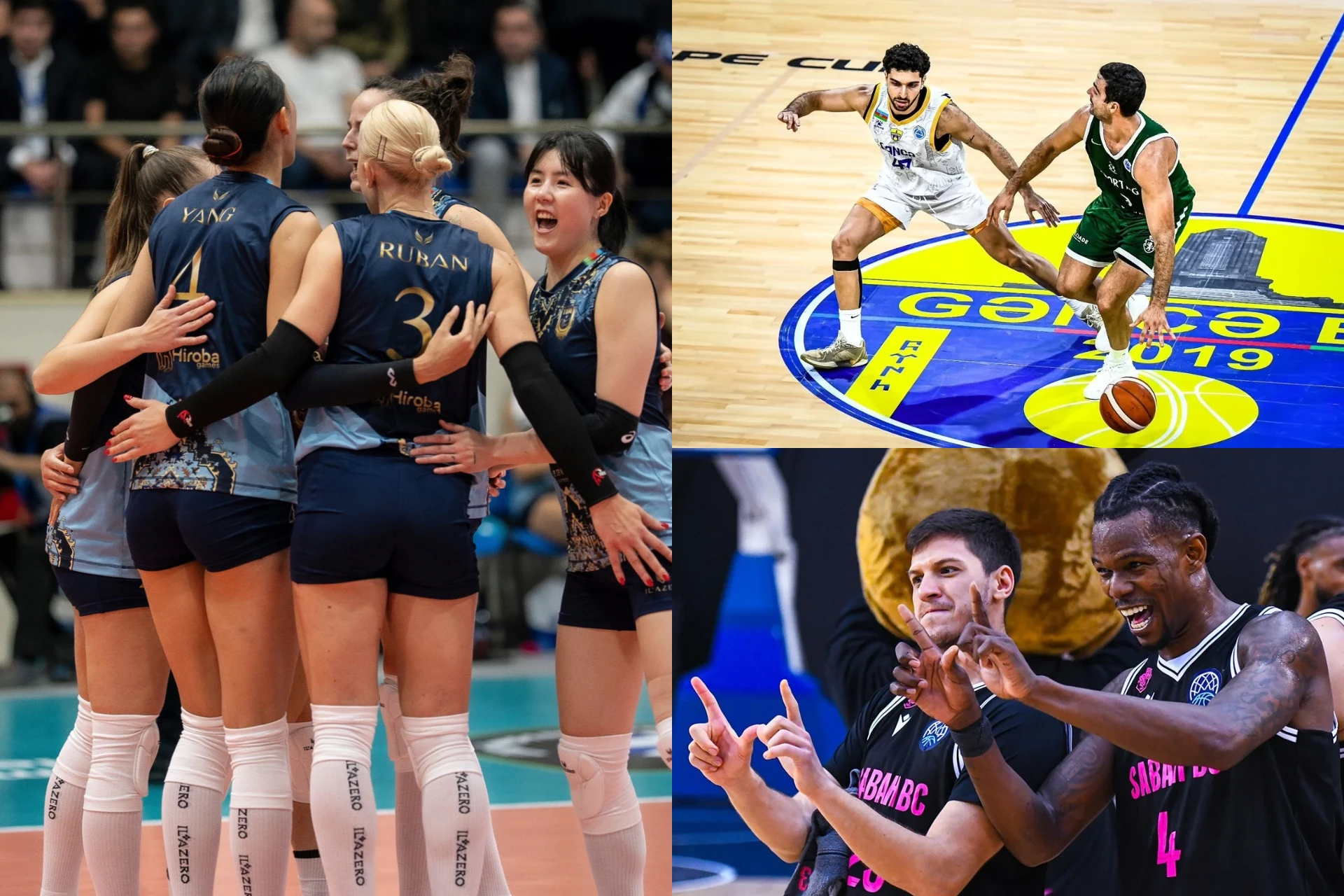
Three of the four teams secured victories. First, Sabah, competing in the FIBA Basketball Champions League, delighted its fans by defeating French side Nanterre 92, 87–80. The game itself turned into a real show, complete with a DJ, cheerleaders from Latvia and confetti. A total of 4,430 spectators watched the match at the National Gymnastics Arena.
Next, in the FIBA Europe Cup, LANDAU Lions defeated Türkiye's Denizli Basket 94–88, while Ganja pulled off a surprise 69–67 victory over Portugal's Sporting in a tense encounter.
Individual achievements also attracted attention. Two players from Azerbaijani clubs delivered outstanding performances on the international stage. Frankie Fidler of Sabah was named Basketball Champions League Player of the Week, while James Fraser of LANDAU Lions scored 41 points against Denizli Basket. Fraser's performance was historic for the FIBA Europe Cup, ranking as the second-highest individual scoring total in a single game in the competition's history.
Naturally, fans would especially like to see similar performances from local players. For now, Azerbaijani clubs lag behind many European teams in terms of squad depth and the number of high-quality domestic players capable of competing with foreign professionals on equal terms. Nevertheless, there are Azerbaijani players who are gradually establishing themselves on the international club stage. There are still relatively few of them, and they sometimes struggle to get enough playing time. Even so, performances like these could represent an important step towards further development.
For Sabah, LANDAU Lions and Ganja, these victories were their first in the current regular season of European competitions. Neftchi remains the only Azerbaijani club yet to win at this stage. However, it is worth remembering that the team qualified for the FIBA Europe Cup by overcoming Estonia's Pärnu over two legs, with an aggregate score of 141–140 (80–67; 61–73). A one-point aggregate advantage was enough to secure progression to the next round.
As a result, for the first time in Azerbaijan's history, four domestic clubs have participated in the group stages of European basketball competitions in the same season. Moreover, Ganja has become the country's first regional club to compete in these tournaments.
Volleyball clubs are keeping pace with basketball. As recently as last season, no Azerbaijani women's club participated in European competitions. The Azerbaijan Volleyball Federation attributed this to the teams' insufficient level of preparation and the need to establish more sustainable club projects. This season, however, the situation has changed considerably.
Two newcomers to European competitions, the women's teams Turan and DH Volley, both began their campaigns with victories. Turan made its debut in the Champions League qualifiers, defeating Croatia's Mladost twice: first 3–0 at home in Tovuz, and then 3–2 away. These results secured the team's place in the third qualifying round, where it will face Bulgaria's Maritsa.
Meanwhile, DH Volley made its debut in the CEV Challenge Cup with a 3–1 victory over Denmark's Holte IF. The return leg will take place in Baku on November 5. Men's volleyball clubs will also join the European competitions next month.
And finally, handball. Despite the crisis facing the sport, the absence of a national championship and months without competitive match practice, the women's team of Kur, currently the country's only active handball club, achieved an emphatic success in the EHF European Cup.
The Mingachevir-based side defeated Cyprus's APOEL convincingly in both matches, winning 40–18 and 39–13 to advance to the tournament's third round. These were the first European competition victories in the club's history.
The men's team, however, was unable to replicate this success. Kur lost both legs against Bosnia and Herzegovina's Sloga, 26–38 and 30–32, bringing its European campaign to an end.
Another noteworthy development is that Azerbaijan's presence on the international club stage is expanding beyond the capital.
According to available official archives, the 2026/27 season marks the first confirmed instance of senior club matches in European competitions being held in four Azerbaijani cities outside Baku: Ganja, Mingachevir, Tovuz and Sumgait, including qualifying matches involving football club Zira.
Ganja hosted basketball club competition matches for the first time. For Tovuz, meanwhile, the opportunity to host a European competition fixture was a long-awaited milestone. Turan's football team played its first European match back in 1994. However, the club was unable to host its opponent at its home stadium because the venue did not meet the required standards. Only 32 years later has the city finally welcomed its first European club competition match, this time thanks to volleyball club Turan.
Mingachevir, meanwhile, is hosting European handball matches. Although the regulations provide for teams to play one leg of a round at home and the other away, all of Kur's matches this season have taken place on home ground. The same arrangement will continue in the next round.
The club's four European matches this season have attracted considerable interest from spectators. At the women's games, fans even had to sit on the stairways because there were no seats left in the stands.
These developments and achievements could undoubtedly have a positive impact on the popularity and growth of these sports. The key is to ensure that participation in European competitions does not remain merely an outward sign of progress, but instead reflects real improvements at every level, from youth development to professional clubs.
Above all, this progress must benefit local players who represent the country in its national teams.
The situation in handball, in particular, serves as another reminder of just how fragile this progress can be. Sports development must be systematic, consistent and focused on the long term. Otherwise, even the achievements already secured can be lost in a single day.


