
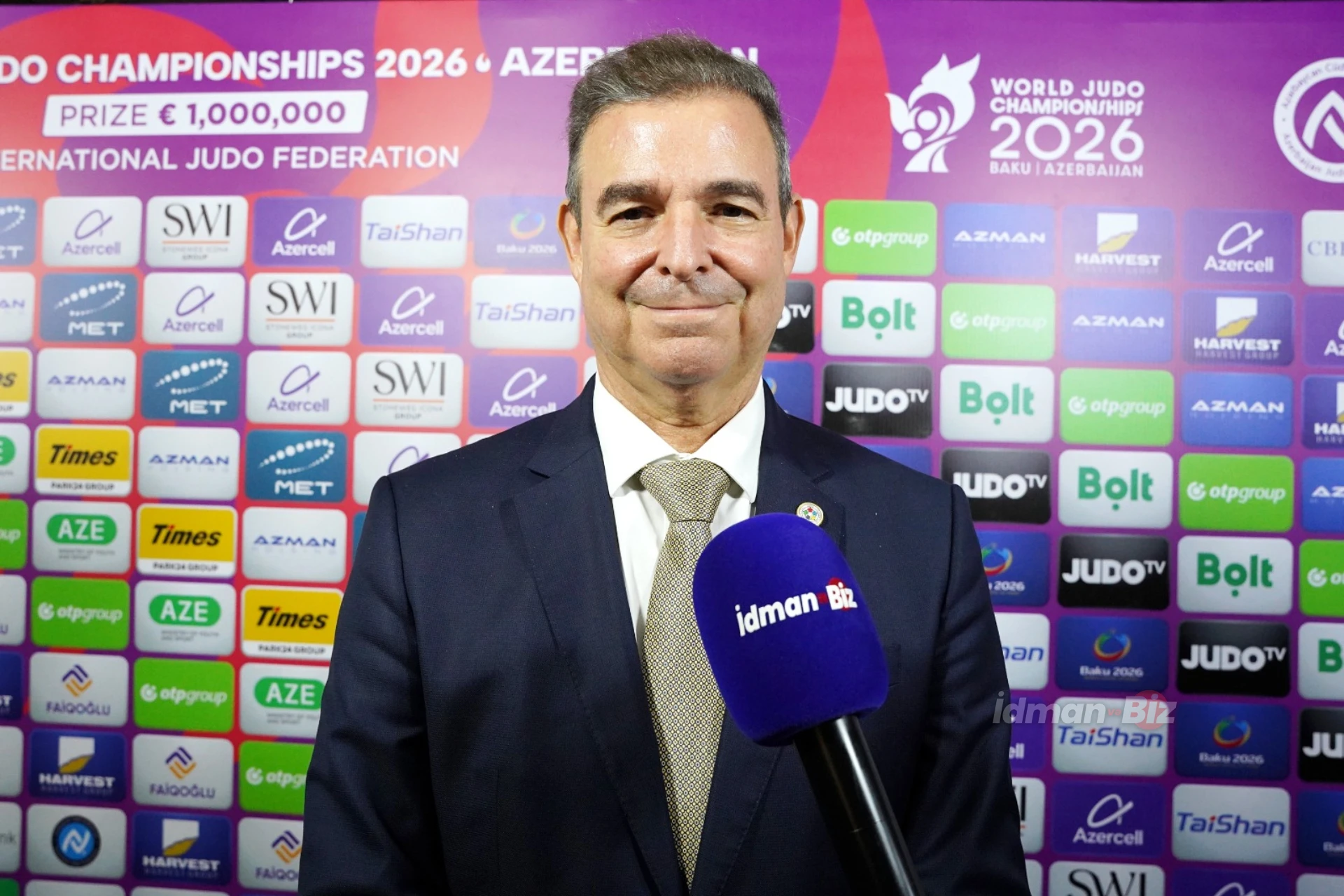
The World Judo Championships in Baku brought together not only the world's strongest athletes but also some of the most interesting personalities in international judo. Among them was Cuban doctor Antonio Castro, the son of Fidel Castro, the revolutionary leader and one of the most prominent political figures of the 20th century.
Antonio Castro holds important positions in international judo. He chairs the Medical Commission of the International Judo Federation (IJF) and serves as Secretary General of the Pan American Judo Confederation.
In an exclusive interview with İdman.Biz, Antonio Castro spoke about his journey into judo, the standard of the World Championships in Baku, prospects for developing cooperation between Azerbaijan and Cuba, and Cuban athletes representing Azerbaijan and other countries.
– How would you assess the organization of the World Championships in Baku? What can you say about the medical services provided during the tournament?
– I was very impressed by the organization. The federation has done a tremendous job. For me, this is one of the best World Championships, and the National Gymnastics Arena is one of the finest sports venues I have seen at our tournaments.
From a medical perspective, the conditions in Baku are truly excellent. The arena is magnificent and extremely well equipped. There isn't just an ordinary medical room here – they have practically created a small hospital. The doctors are also highly experienced.
We are very satisfied with their work, and we will try to build on this experience at other competitions held in Azerbaijan in the future.
– During the World Championships in Baku, French judoka Sarah-Léonie Cysique suffered an injury and was taken to hospital for examination. Do you have any information about her current condition?
– The level of competition at the World Championships is extremely high, and the athletes are very well prepared. Nevertheless, there have not been many injuries at this tournament. Frankly, we are surprised by that ourselves.
In the case of the French athlete, everything was handled very well and very quickly. We were there with her, trying to help and provide the necessary guidance.
In such situations, we have to make certain decisions, but this time everything was organized perfectly. In the end, no serious problem was detected. However, when an athlete complains of pain, we must follow the established protocol. That is why we sent her to hospital for examination.
Everything went smoothly and was handled very professionally.
– Looking at your biography, it seems that your own sporting experience influenced your decision to become involved in judo in a different capacity. You also practiced judo yourself when you were younger...
– Yes, there is an interesting story behind that. I practiced judo until I reached the yellow belt, and then I switched to another sport.
I suffered a knee injury. I was very young, around 16 years old. I was playing football when I got injured.
After that, I started thinking about what I could do in the future to help athletes. I had wanted to become an athlete myself, but I got injured. So I began wondering how I could help people who wanted to participate in sports avoid facing similar problems.
That is how I decided to study medicine and became an orthopedic traumatologist. Later, I started working with the Cuban delegation at the Olympic Games. After that, I joined the International Judo Federation.
This is the first time in my life that I have spoken about this, and I am happy to do so here in Baku, Azerbaijan.
I became a sports doctor because, after suffering an injury in my youth, I wanted to take care of athletes. I think it is a very beautiful story, even a spiritual one in some ways.
– As both a sports official and a former judoka, following the World Championships must be particularly interesting for you. Did you expect the medal competition to unfold this way?
– Everyone is fighting for medals. But I think the most important thing is that all the athletes are here together.
We all know that we are living through difficult times. People are fighting wars in different parts of the world. But judo has created a space for peace and friendship here in Baku.
Here, people can compete, learn both how to lose and how to win, and work together as a team. I believe that is the real reward judo brings to a person's life.
As for the medal standings, some countries are indeed very strong. Azerbaijan is also achieving very good results, and that is wonderful.
When an athlete wins a medal, it also reflects, in a certain sense, what society is doing for its citizens. You demonstrate to the whole world that you pay great attention to your people.
The same can be said, for example, about Japan. But for me, the most important thing remains the values that judo brings into people's lives.
– You are the Secretary General of the Pan American Judo Confederation. So far, athletes from your region have not managed to win any medals...
– The competition is not over yet. We hope that we will be able to win several medals before the end.
But in any case, this is a tremendous experience for our athletes. We have spoken with our judokas, and they understand that things are not always easy. The level of world judo is extremely high.
We have plans to further promote and develop this sport in Pan American countries.
Our judokas are very happy to be here and to have the opportunity to compete against the best athletes in the world. This is a great opportunity for them.
But sometimes you cannot achieve the result you want. They make enormous efforts, show great dedication and give everything they have to win medals. But that is sport – you either win or lose.
You have to be strong, brave and courageous, represent your country with honor and compete with dignity.
– By the way, how is judo developing in Cuba at the moment?
– Cuba continues to develop all sports and is working to improve the quality of training.
Of course, the economic situation is not easy. But the athletes continue to compete and maintain their fighting spirit.
Speaking specifically about judo, you can see for yourselves how much effort they have made just to come here and compete at this level. They are real fighters.
– Cuban-born Ayumi Leiva Sanchez, who now represents Spain, won a bronze medal at the World Championships in Baku. Did you have an opportunity to speak with her and congratulate her?
– After she won the medal, I personally went up to her, hugged her, kissed her and congratulated her. I told her, "I am very happy for you. I am proud of you."
Yes, she represents Spain. But I can tell you that we treat all athletes this way – Georgians, Azerbaijanis and Japanese athletes as well.
We also have another Cuban athlete who represents Romania. He had some minor bleeding and came to me. Since he speaks Spanish, I went over to him and said, "Don't worry, everything is fine."
A local doctor treated him, and he then returned to the competition.
This is how we treat all athletes, and we are proud of our judokas.
– So you continue to support Cuban athletes even when they decide to represent other countries?
– Of course. Everyone is free to choose where they want to compete.
The IJF has its own rules, and athletes must follow them. But they can represent whichever country they choose.
I want to emphasize once again that judo is a space of freedom and peace. It is a space that is open to everyone.
– Azerbaijan has had, and still has, Cuban boxers representing the country. Some of them have achieved success at the Olympic Games. How would you assess the contribution of Cuban athletes to the development of Azerbaijani sport?
– I think Cuban athletes demonstrate their abilities not only in Azerbaijani sport but all over the world. They show that they know how to win and how to earn medals.
I am particularly happy about their successes in Azerbaijan.
The Cuban boxing school has a very long tradition, and its standard is extremely high. I am happy that Cuban athletes are helping other countries win medals.
This is also good for the Cuban athletes themselves. They live in other countries, achieve success and bring happiness both to themselves and to Cuba. They are also warmly welcomed in the countries they represent.
It is good for everyone.
– Finally, are there any plans to implement joint projects between Cuba and Azerbaijan?
– I had a very good opportunity to meet Azerbaijan's sports minister here in Baku.
We discussed future cooperation in detail, and the conversation was not limited to judo. We talked extensively about cooperation in judo as well as the broader future of relations with Cuba.
We have a lot of work to do. He has some very good ideas. He is a wonderful person, loves sport and wants to do a great deal for his country.
I can say that we will work together. I am also very happy to have the opportunity to help him strengthen our friendship even further.


